
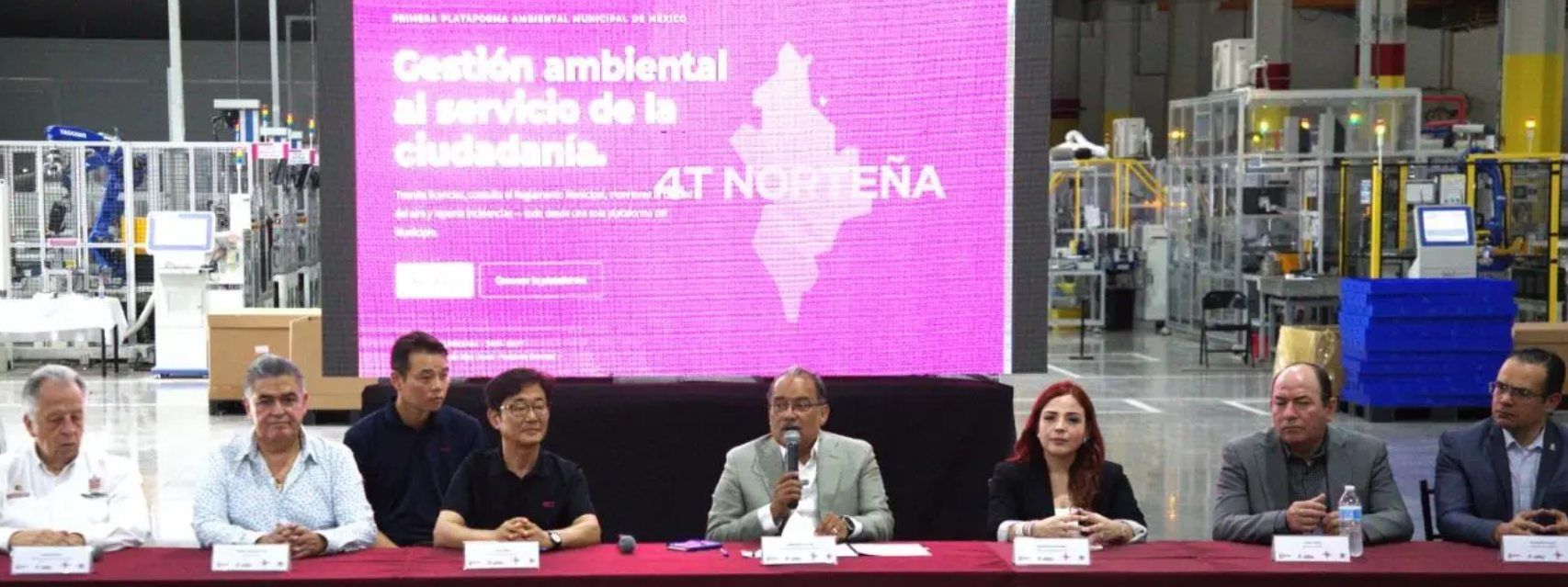
Photo: Government of Escobedo.
There are projects that seem small at first, but end up marking a before and after. This is exactly what is happening in the municipality of Escobedo, in the state of Nuevo León, Mexico. Under the leadership of its mayor, on May 24 the municipality presented its new 100% digital platform for environmental procedures, the first of its kind in the country.
Andrés Mijes, municipal president of Escobedo, presented the new environmental regulations to the media at a ceremony held at the facilities of the Seojin Mobility plant. The regulation includes key guidelines on climate change, sustainable mobility and the creation of a digital one-stop shop for environmental procedures. During the event, the mayor also announced the launch of the air quality monitoring system, based on Bettair technology, focused on issuing timely recommendations and alerts to the population.
The first two of a planned network of ten stations are currently operating and will be progressively installed in the coming months. The municipality’s digital platform, developed by Mexican consultants, integrates environmental information, establishment registries, environmental licenses, QR compliance codes and other services. The initiative stands out not only for incorporating advanced air quality monitoring technology, but also for something unusual in Latin America: the actual integration between a public environmental platform and real-time environmental data via API.
A new way of understanding environmental management in Escobedo
For years, many Latin American cities have faced the same problem: making environmental decisions with limited information, without sufficient local and real-time data.
Air pollution is constantly changing; it depends on traffic, weather, industrial activity and even the time of day. That is why measuring from a single point is no longer sufficient to understand what is really happening in an entire municipality.
Escobedo decided to move towards a different model. Its new 100% digital platform The environmental management system directly integrates environmental information, facility registries, licenses, compliance QR codes and other services. In this way, the project goes beyond the installation of technology: it represents an evolution towards smarter, more accessible and connected environmental management.

The importance of an intelligent environmental monitoring network
The big difference between having an isolated station and having a complete network is in the ability to understand real pollution patterns.
With multiple strategically distributed stations, areas with higher pollution can be identified, environmental changes can be detected quickly, and more accurate air performance maps can be generated.
The progressive installation of Bettair IoT stations will allow the municipality to build a much more detailed view of its environmental conditions.
As connected air quality sensors, the information can be visualized in real time and used to improve environmental processes, technical analysis and future urban strategies.
Through continuous monitoring, pollution episodes can be detected, trends can be understood, areas can be compared and action can be taken more quickly. This is especially useful in municipalities with urban and industrial growth, where air quality can vary significantly between different areas.
Bettair and environmental digitalization in Latin America
One of the most important points of the project is the integration via API between the digital platform developed by Mexican consultants and the Bettair platform.
Although it may seem like a technical detail, it actually represents a significant advance. It means that environmental information ceases to be isolated in separate systems and becomes part of a connected and dynamic digital infrastructure.
This opens the door to multiple benefits:
- Greater environmental transparency,
- Faster access to information,
- Process automation,
- and improved analytical skills.
In a context in which Smart Cities are advancing rapidly in other regions of the world, projects such as Escobedo’s help position Mexico and Latin America within a new generation of data-driven urban management.
How Bettair stations help improve environmental management
Bettair stations not only measure pollutants; they also generate useful information for public management and territorial planning. The monitoring platform allows the visualization of historical and real-time data, converting complex information into practical tools for decision making.
With this network, authorities can identify patterns, assess the impact of industrial activity, analyze the influence of traffic and climate, and design more specific actions to protect the health of the population. This is especially relevant in municipalities with strong urban dynamism, where understanding how air quality varies between neighborhoods or industrial zones is key.
Air quality as part of the urban future
Air quality is no longer just an environmental issue; it is also related to health, mobility, urban planning and quality of life. That is why projects like Escobedo’s have an impact that goes beyond technology. They bring environmental information closer to institutions and, eventually, to citizens, facilitating a better understanding of the urban environment.
With this vision, the municipality of Escobedo presents a new environmental regulation scheme that integrates digital tools and an updated legal framework. The objective is to strengthen the management of the territory and industrial activity under sustainability criteria, complementing the regulations with real-time data on air quality.
A project that can set a regional precedent
The interesting thing about this initiative is that it is not limited to installing equipment. The real value lies in the combination of digitization, environmental monitoring, technological integration and centralized access to information. In Latin America there are still many municipalities where air quality is analyzed with limited or fragmented information, which makes decision-making difficult.
Escobedo is committed to a different approach: creating a connected environmental infrastructure from the outset. The gradual installation of the Bettair network over the next few months will be an important step to consolidate this new model of intelligent environmental monitoring in Mexico. This project may become a reference for future environmental networks in other cities in the country and the region.
About dnota

More information on how dnota can help you control the air we breathe is available on our website www.dnota.com and our social networks, where you can see all our products and services.
We also have our #videocorporate with the vision that note of how to control the air we breathe. dnota LinkedIn Twitter Youtube
Technological Updating and Environmental Commitment
The work also includes upgrading the software and hardware systems used in the surveillance network. This ensures that the data collected is accurate and available in real time for analysis. This is crucial to react in a timely manner to any increase in pollution levels. This ensures the health and well-being of airport workers and passengers.
The award of this Air Quality Monitoring Service reaffirms Dnota’s commitment to environmental protection and public health. With its expertise and advanced technology, Dnota will contribute significantly to the improvement of air quality. This is especially relevant in one of Barcelona’s most important infrastructures.